Three Hacks to Master That Will Level Up Your Breeding Abilities

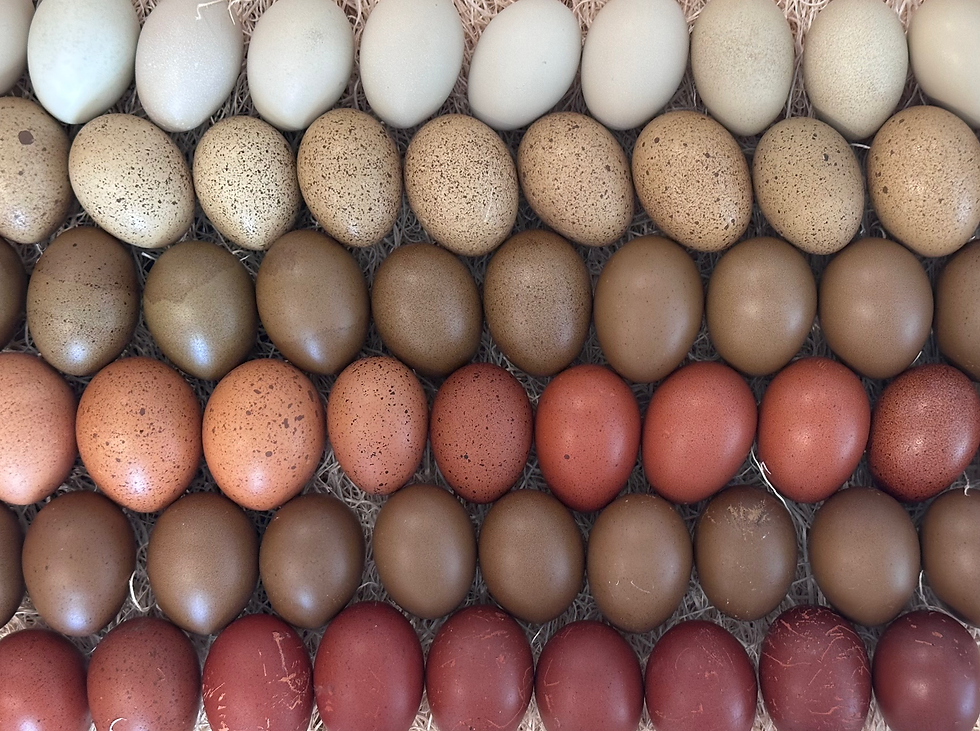
Breeding chickens is one of those rare disciplines where art, science, intuition, and a willingness to be humbled all collide on a daily basis. Whether you’re brand new or you’ve been knee-deep in feathers for decades, there’s always something more to learn, and the quickest way to accelerate your progress, prevent heartbreaking setbacks, and make consistently better decisions is by mastering three core concepts.
These three “hacks” aren’t shortcuts. They’re not even complicated. But they are the foundation of every well-run breeding program, and when you truly internalize them, not just memorize them, but understand them, your entire approach transforms. Think of this as the natural sequel to my blog on epigenetics and a perfect companion to the blue egg gene deep dive.
Let’s get into it.
Hack 1: Master the Understanding and Difference Between Monogenic and Polygenic Genetics and How They Are Expressed
Every trait in a chicken from comb type to egg color, feather sheen to temperament, falls into one of two buckets:
Monogenic traits: governed by one major gene
Polygenic traits: governed by many genes, many loci, many modifiers, and sometimes many surprises
Once you understand which category you’re dealing with, everything becomes easier.
Monogenic Traits: The Clean, Predictable Ones
Monogenic traits are the easiest to understand because they’re controlled by a single major gene. “Mono from the Greek word for “one” gives us very clear guidelines when it comes to genetics. Monogenic traits follow Mendelian rules:
Dominant: only one copy needed to express
Recessive: need two copies to express
Wild type: the ancestral default (no copies)
Common monogenic traits include:
Pea comb vs. single comb
Yellow skin
Muffs and beard (Mb gene)
Crests
Feather type (silkie, frizzle)
Sex-linked colors (barring, gold/silver)
Dominant white, recessive white, lavender
Polydactyly, vaulted skull, etc.
These are the easy wins. If you breed two homozygous pea-combed birds, you will get pea-combed offspring every time. If you cross two birds carrying recessive genes for pea-combs, it’s not a sure thing, but you can still calculate your probabilities. You can predict monogenic traits on paper.
Phenotype: What It Is and Why It Matters
Before we go any further, let’s define one of the most important words in all of genetics: phenotype.
A phenotype is simply the collection of visible traits a chicken expresses: everything you can observe with your eyes. It’s the bird’s outward manifestation of its genetics in the real world.
For example, when you look at an Ameraucana, you can identify its phenotype by traits such as:
the pea comb
the muffs and beard
the slate legs
the blue eggs
and, optionally… extreme cuteness (fine, that one’s not genetic, but it should be lol)
When you evaluate a bird’s phenotype, you’re looking at which genes are actually expressing, not merely which genes it carries. This distinction matters, because a chicken can carry a trait without expressing it, especially when dealing with polygenic traits or recessive alleles.
Phenotype is your most reliable window into what’s happening genetically. It tells you:
what traits are active
what traits are suppressed
what traits are incomplete
what traits are reliably passed on
and which traits need further selection pressure
Understanding phenotype allows you to evaluate birds with precision, select your breeders wisely, and move your program toward your goals with intention.
Only once you understand phenotype can you truly begin to judge genotype (the underlying genetic architecture) and the relationship between the two.
If you hatch a clean-faced Ameraucana, the phenotype tells you immediately: the Mb gene was not expressed, due to the absence of the gene (wild type).
Genotype: The Blueprint Behind the Bird
If phenotype is what you can see, then genotype is everything you can’t: the full genetic blueprint a chicken carries in its DNA. The genotype includes all the alleles, modifiers, enhancers, suppressors, and combinations (expressed or unexpressed) that shape what a bird could be. Some of those genes will show up plainly in the phenotype; others will stay hidden unless the right pairing, combination, or environmental trigger brings them forward.
Understanding genotype helps you recognize that a bird can carry traits it does not currently express, which is why relying on phenotype alone can be misleading unless you understand the relationship between the two. The best breeders learn to evaluate birds through both lenses: what a bird is, and what it has the potential to pass forward. Hence the second part of the avian genetic equation: Polygenic traits.
Polygenic Traits: Where Breeding Becomes an Art Form
Polygenic traits are the opposite of tidy. These are your multi-gene, multi-locus, multi-modifier traits… the ones that require patience, measurement, consistency, and ruthless selection.
Examples include:
Egg shell darkness
Olive shade richness
Bloom intensity
Feather lacing quality
Feather sheen
Copper richness
Tail angle
Body width
Growth rate
Temperament
Immune strength
Heat/cold tolerance
Hatchability
Each of these traits is influenced by many genes, each one contributing a small effect. Some enhance. Some weaken. Some suppress. Some only activate under certain hormonal or environmental conditions (epigenetics).
The DJ Board Analogy
Imagine a DJ standing at a mixing board with 40 sliders: bass, treble, mids, reverb, distortion. No single slider creates the sound… the blend does.
That is polygenics.
This is why two birds can carry roughly similar genetic components but express drastically different results: the “sliders” aren’t set the same way genetically, epigenetically, or environmentally.
Hack 2: Understand the Biology of Egg Pigmentation
If you want to intentionally produce rich olive, deep russet Marans, sky blue, or bloom-heavy pink eggs, you absolutely must understand the pigments involved.
There are only two pigments in chicken eggshells (with respect to outward egg color expression):
Biliverdin = blue
Protoporphyrin IX = brown
In my earlier blog, Understanding the Blue Egg Gene, we learned that blue eggs result from biliverdin being deposited throughout the shell matrix (thanks to the O gene). Whereas brown eggs result from protoporphyrin being applied during the final hours of shell formation over either a white or blue egg.
From these two pairings, you get green.
Blue + Brown = Green. Always.
There is no “green gene.” No secret pigment. No magical third color.
If a blue layer produces any shade of green, even teal, protoporphyrin is present, period.
I recently challenged this absolute with a biologist friend who teaches at Stanford. We explored a hypothetical jaundice-like pathway that could distort biliverdin metabolism enough to mimic green, but the conclusion was clear:
Hypothetically possible in an individual bird
Likely not heritable due to loss of fertility/viability
Not scalable due to loss of vigor
Natural selection would take out the birds quickly with this modifier
Thus: If it’s green, brown is in the mix.
But egg color doesn’t just depend on pigment. It depends on how fully the bird expresses the entire architecture required to deposit that pigment. Which leads us directly into the heart of the blog…
The Part Almost Everyone Gets Wrong: Why You MUST Select Based on Expression, Not Potential
Most people assume:
“If a hen has the genetics to lay a dark egg, her chicks will too… regardless of how dark the eggs she lays actually are.”
NO. That assumption derails breeding programs for years and is often based in mammalian genetic principles not avian genetics. Avian genetics, particularly chickens, turn their genes over every time they lay an egg. The genetic propensity of the offspring from that egg will change EVERY single time a new egg is laid. EVERY. TIME.
Here’s why:
Truth #1: Polygenic traits only reveal themselves when every contributing gene AND modifier AND enhancer is actively engaged.
A hen can carry extensive dark-egg genetics and still lay lighter eggs if:
a modifier is suppressed
an enhancer isn’t activated
hormones shift
stress impacts pigment deposition
diet shifts
she’s close to molt
immune response is triggered
epigenetic switches flip OFF
pigment transporters underperform
mineral balance fluctuates
Only a fully-expressed egg proves all the necessary components were ON. That is why the peak eggs are the gold standard for selection.
Truth #2: Egg pigment traits are heavily epigenetic.
Your dark-egg hens do not lay dark every single day because pigment pathways respond to:
internal physiology
external stress
seasonality
hormone cycling
nutrient status
oviduct micro-environment
temperature variations
shell gland wear
Each egg is a biological snapshot of the genetic architecture in action at that exact moment.
Lighter egg = partial activation.
Darker egg = full or fuller activation depending on her highest output.
Both eggs came from the same bird, but they are not genetically equivalent for breeding. It doesn’t work the same in avian genetics as it does in mammals.
Truth #3: Polygenic traits are additive, and additives only matter when they’re actively expressed.
A hen laying an 8 on the Marans scale is expressing:
strong pigment deposition
absence of pigment suppressors
multiple enhancing alleles
optimized transport pathways
high metabolic availability
peak epigenetic activation
physiological conditions aligned with maximal expression
If she then lays a 5, then at least one part of that complex stack is not functioning at full capacity. Thus:
An 8 egg and a 5 egg from the same hen do NOT have equal probability of producing dark layers. This works for EVERY version of her egg.. not just Marans. Olive eggers, chocolate eggers, whatever you call them.. are all effected by daily epigenetic changes.
The darkest eggs carry the strongest “all systems GO” signal.
Truth #4: This is why only setting peak eggs leads to rapid improvement.
You’re not breeding from genetic “potential.” You’re breeding from proven performance: the phenotype that tells you the full genetic stack is functioning.
This is why I always say: Never. Ever. EVER.. Set an egg you don’t want to see again, because you will.. and it won’t be pretty. Not only will you not get the outcome you are after, but it will drag down your entire program in one season. BUT, if you remain steadfast in this principle, you can improve your lines in just ONE cycle.
Truth #5: Chickens respond dramatically fast to selection pressure.
This is because chickens:
Reproduce quickly
Produce large numbers of offspring
Have narrow generation gaps
Reset epigenetic states rapidly (multiple times a day!)
Have limited recombination interference
Show strong directional selection responses
Even mammals can’t match the speed with which poultry respond to phenotype-driven selection.
This is why your selection choices matter so much, and why mistakes can compound quickly.
Hack 3: Master the Math of Probabilities
This is the hack most people want to skip, but please don’t. Understanding basic probability is essential when working with polygenic traits.
Let’s get to know the midpoint cluster heuristic, one of the most powerful tools in a breeder’s arsenal. It’s simple to apply and it works shockingly well in breeding.
To use the Marans egg color chart as an example, if your hen lays an 8 and your rooster hatched from a 4, most offspring should cluster near a 6:
(8 + 4) / 2 = 6
This is not a precise formula… it’s a predictive model based on how traits distribute across populations.
Using the 70–25–5 bell curve heuristic:
70% of offspring land near the midpoint (6)
25% land slightly above or below (7/8,4/5)
5% are extreme outliers (3,9)
You can assign a 1–9 scoring scale to almost any polygenic trait:
Egg darkness
Olive depth
Copper intensity
Feather sheen
Lacing crispness
Egg size
Tail angle
Bloom strength
Once you score, you can model. Once you model, you can refine. Once you refine, you can improve.
As a data scientist, I collect massive quantities of data on my birds, but the truth is, what you have here in this blog will get you 90% of the way there. The rest is just pushing margins and possibilities. Score what matters, compare the results over a season, and then use the same principles to level up again and again.
Why We Trust This Model: The 50/50 Sex Ratio Example
Through millions of years of evolution, Mother Nature has set a precedent in every species that aims to balance the sexes of every living creature. Which is why, on paper we say that there is a 50/50 chance of a pullet versus a cockerel. But anyone who hatches regularly knows that individual hatches rarely land at 50/50.
You might have:
80/20
70/30
60/40
Yet when you average multiple hatches across a season? You get remarkably close to 50/50 (not accounting for other variables like shipping stress, varying efficacy of incubators, etc.)
This is the same principle that makes the midpoint heuristic so reliable. One hatch isn’t enough data, but many hatches tell the truth.
This is why your breeding decisions should be grounded in probability, not in single-hatch anomalies. Spread over a season, you are going to get excitedly close to this midpoint heuristic model. So, now I will reintroduce the Golden Rule:
Never, ever set an egg you don’t want to see again.
Because:
✔️ The peak egg demonstrates full genetic + epigenetic activation
✔️ Lighter eggs show a weakened additive stack
✔️ Selection pressure works up AND down
✔️ One mistake can set you back years
✔️ One season of strict selection can leap you forward
You are breeding performance, not possibility.
Bringing It All Together
When you combine:
the clarity of monogenic predictability
the nuance of polygenic additivity
the biology of pigment pathways
the power of epigenetic expression
the math of probability
the speed of chicken reproduction
You stop “hoping” for the traits you want and start creating them. This is the real difference between breeding and multiplying. Between keeping chickens and developing a line. Between guessing and intentionally shaping the outcome.
Master these three hacks and your breeding program will level up faster, and with more precision, than you ever imagined. In the next blog, Unlocking the Heme Pathway, I will present a few ways you can dial up the epigenetic mixer and create a symphony of greatness to unlock your hens’ genetic pigment potential.
You can’t manifest genes that aren’t there, but we can unlock the ones that are with epigenetic influences. Through the heme pathway, the metabolic river that feeds protoporphyrin production and determines how dark, how rich, and how consistently your birds can lay, we can apply epigenetic strategies that can encourage your hen to reach her maximum potential. It’s where genetics meets physiology, where environment meets expression, and where some of the biggest breeding breakthroughs are hiding in plain sight.
Happy breeding. 🐓💛


Comments