
Understanding the Blue Egg Gene: Heterozygous vs. Homozygous, and Why Even “True Blue” Chickens Sometimes Lay Green Eggs


For many chicken keepers and breeders, blue eggs seem simple on the surface: breeds like Ameraucana, Araucana, and Legbars are known as “true blue” layers. In theory, these birds should lay pure blue eggs when they carry the homozygous blue-egg genotype (O/O).
So why do some hens from these breeds occasionally lay greenish-tinted, teal, or aqua eggs instead of a clean blue?
The answer lies in understanding:
The genetics of the blue egg gene (O)
The difference between heterozygous (O/o) and homozygous (O/O)
The persistent, long-lasting influence of protoporphyrin, the pigment that creates brown egg color
How ancestral crossings - even many generations back, leave behind polygenic brown-tint modifiers that subtly affect egg tint today.
This blog will break down each component clearly and give you real-world, breed-specific examples (including Ameraucana and Silverudd’s Blue).
The Blue Egg Gene (O Locus): What It Actually Does
The blue-egg gene, commonly called O (oocyan), is a dominant genetic mutation originally found in the Araucana. The gene actually began with a virus (yes, really.) Long ago, a harmless ancient virus inserted a tiny piece of its DNA into the genome of chickens in South America (Chile).
Instead of causing harm, this little genetic “stowaway” switched on a gene that made the hen deposit blue pigment, called biliverdin, all the way through the eggshell, not just on the surface. That’s why true blue eggs are blue inside and out. This viral event happened once in history, and every blue-egg breed today - Ameraucana, Araucana, Cream Legbar, and others - traces back to that original viral insertion. (Pretty cool, huh?)
What O does:
Unlike brown pigment (protoporphyrin), which is painted onto the shell surface, blue pigment (biliverdin) is deposited throughout the entire shell matrix as it forms.This means:
Blue eggs are blue inside and outside
The pigment is intrinsic to the shell, not a coating1
Heterozygous (O/o) vs. Homozygous (O/O): Why It Matters
Heterozygous (O/o):
A bird with only one copy of the O gene.
Still lays blue eggs
But biliverdin deposition is often slightly lower
Blue layer may show more variation
More susceptible to brown-tint influences from protoporphyrin
Homozygous (O/O):
A bird with two copies of O.
Deposits more biliverdin
Typically produces a cleaner, stronger blue
More resistant to brown “bleed-through”
BUT - and this is the key point - neither genotype can fully prevent lingering protoporphyrin from tinting the egg. This is where most people misunderstand.
Why Some Homozygous Blue Layers (O/O) Still Lay Green-Tinted Eggs
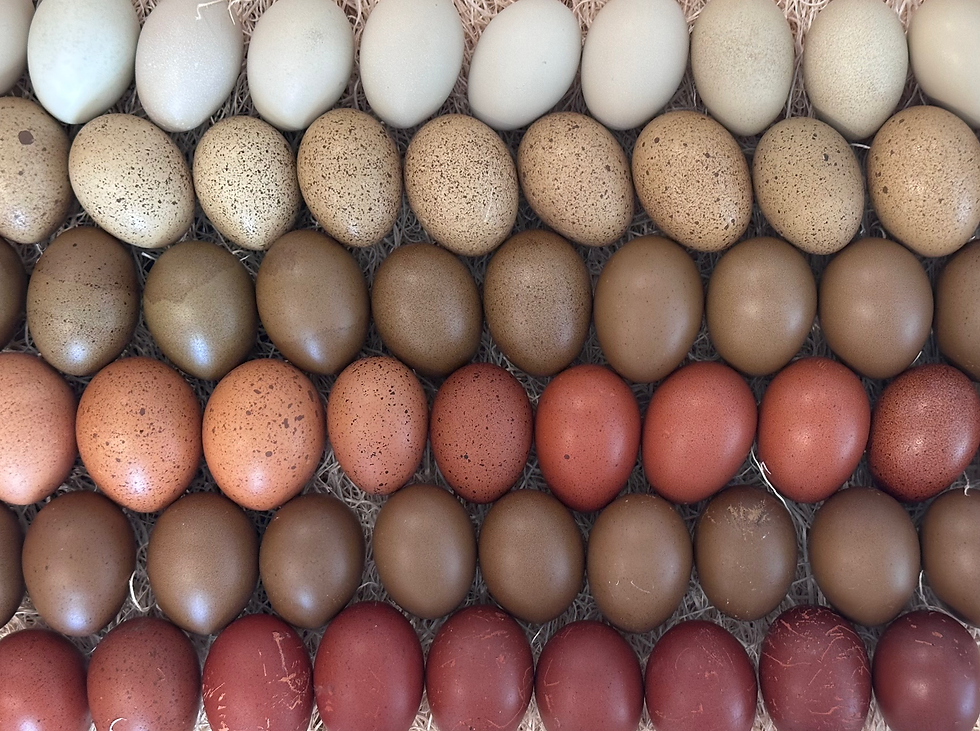
Contrary to popular belief, green eggs are NOT created by a “green gene.”They are created by: Blue base (biliverdin) + Brown overlay (protoporphyrin)2
Even if a bird is O/O, meaning it should produce clean blue eggs, brown-tint genes from past ancestry can remain active.
Protoporphyrin is polygenic and persistent.
Unlike the O gene, which is a single, dominant locus, brown eggshell color comes from many genes (polygenic), meaning:
They behave unpredictably
They can persist silently for generations
They can be partially expressed
They can come from an extremely diluted or distant brown-egg ancestor
This explains why even well-bred Ameraucanas occasionally lay aqua or green-tinted eggs.
Where Does the Brown Tint Come From?
To get a green tinted egg, there must be brown-egg ancestry somewhere, because the brown pigment (protoporphyrin IX) can only come from a brown layer lineage, and green tint can only be created by combining brown with blue.
Sometimes this brown influence is recent (e.g., Olive Egger), but it can also be 10–20 generations back and still exert microscopic tint influence. This is especially true in breeds that were developed from mixed stocks, such as Silverudd’s Blue.

Case Study: Silverudd’s Blue (formerly “Isbar”): A Breed Built on Brown + Blue Genetics
Silverudds are a perfect example of Pp IX's persistence because they were intentionally developed to be green layers by Father Martin Silverudd in Sweden.
How Silverudds Became True Green Layers:
The breed began with blue-egg Araucana-type stock
Crossed with brown-egg layers (likely landrace, Leghorn, or other Swedish breeds)
Breeding selection emphasized consistent green, not blue
This combination created:
O gene (for biliverdin)
Stable protoporphyrin modifiers (polygenic, inheritable)
Over generations, these modifiers produced consistent green overlays - not heavy brown paint, but subtle enough that the shell is a true olive/green (not speckled brown).
Important point:
The protoporphyrin remains part of the genetic background, even if the breeder later selects for birds that lay lighter green. Whether this residual genetic trait will show in your bird or not is dependent on a number of factors (some within your control, and some not). You can select for this trait and breed to intensify it, or select away from it to try to reduce the probability of it showing up, but in the end, it will come down to how effective your bird is at expressing that desirable or undesirable trait (more on this in another blog).
This is why Silverudds are an ideal educational example: They show how intentional incorporation of brown-egg genetics can create a stable green egg even when the bird is homozygous for the blue gene.
Why Ameraucana Sometimes Lay Greenish Eggs (Even O/O Birds)
Ameraucana breeders strive for clean blue eggs, but historical records show that:
The breed was standardized in the 1980s
It was developed from non-standardized Araucana derivatives
Many early lines had mixed brown-layer influence3
Even decades later, some Ameraucana lines still contain:
Weak brown-tint modifiers
Variable protoporphyrin deposition
Ancestral brown-egg background
Thus even an O/O Ameraucana can produce:
Pale blue (ideal)
Blue-green
Aqua
Greenish tint
The difference depends mainly on how many brown modifiers are still expressing. Monogenics and Polygenics are two of the most important tools we can use when selecting for desirable and undesirable traits as we breed. As an Ameraucana breeder, I only want the truest blue eggs. In order for me to to continue to observe that in my line, I must meet all of the following minimums:
A fully homozygous flock so as to lessen the probability of ancestral Pp IX expressing in my offspring
Setting the bluest eggs only and NEVER setting a green tinted egg (even slightly tinted!)
Never breeding back to a layer that expresses green tint.
By following these simple principles, we can significantly decrease the probability of the Pp IX expressing through the strong Biliverdin foundation we have created.
Summary: Key Takeaways
✔ Blue eggs come from the O gene, depositing biliverdin throughout the shell
✔ Heterozygous (O/o) = one copy of the blue egg gene
✔ Homozygous (O/O) = two copies of the blue egg gene
✔ Green eggs = blue base + brown overlay (protoporphyrin IX)
✔ Brown pigment is polygenic, persistent, and can influence eggs for many generations
✔ Even perfect “true blue” breeds can show ancestral brown tint
✔ Silverudd’s Blue is the best modern example of intentional green-egg genetics
✔ Clean blue requires generations of selecting against brown modifiers
Citations:
Wang et al., PLoS Genetics, 2013; Ito et al., Pigment Cell Research, 2005
Kennedy & Vevers, Avian Biology, 1976
American Poultry Association; Ameraucana Breeders Club archives

Comments