
Unlocking the Heme Pathway

Part One: The History, Biochemistry, Genetics, and Physiology Behind the Dark Egg

A brief history of the Marans breed of chicken begins in Coastal France. The marshlands surrounding the port town of Marans were not gentle places to raise poultry. Long before the Black Copper Marans became celebrated for its deep mahogany eggs, the breed was developing within the cold Atlantic lowlands of western France: A landscape defined by salt air, dense humidity, standing water, mud, fluctuating temperatures, and relentless environmental pressure. These were not conditions that tolerated fragility. The birds that survived there were not ornamental birds bred for exhibition. They were birds shaped by adversity.
The town of Marans itself sat along active maritime trade routes, where sailors and merchants routinely passed through with livestock from distant regions. It is believed that local French landrace chickens were crossed over generations with imported fowl arriving through the port, introducing new bloodlines from England, Asia, and other European coastal regions. Yet while many new genetics may have entered the marshes, only certain birds persisted. The environment itself became a selective force.
In the wet marshlands, bacterial pressure would have been immense. Eggs laid into damp nesting conditions faced constant microbial exposure, and fragile shells would have represented a direct reproductive disadvantage. Over time, birds capable of producing stronger shells, heavier bloom, and more resilient reproductive systems would have been naturally favored. The dark egg may therefore have emerged not merely as a cosmetic curiosity, but as the visible consequence of generations of selection for reproductive durability under difficult environmental conditions.
In a coastal trading town like Marans, survivability did not end at the nest box. Eggs were transported through damp air, unstable temperatures, muddy terrain, horse carts, and long maritime routes where fragility carried economic consequence. Thin-shelled eggs or eggs with weak cuticle integrity would have been more vulnerable to cracking, bacterial penetration, dehydration, and spoilage during transport.¹³⁻¹⁵ Over generations, birds producing denser shells, heavier bloom, and more resilient eggs would have offered a practical advantage not only for hatchability, but for commerce itself.¹³⁻¹⁵ The dark egg may therefore have become unintentionally linked with transport durability and preservation long before breeders ever standardized shell color as a formal trait.
The thick matte bloom so prized by modern Marans breeders may not have originated as ornamentation at all. In the humid marshlands of western France, that heavily mineralized cuticle may have functioned as an additional biological barrier against moisture exchange, microbial intrusion, and environmental stress during storage and transport.¹³⁻¹⁵ What modern breeders celebrate aesthetically may once have been fundamentally utilitarian.
The dark egg was not merely beautiful.
It survived.
This context fundamentally changes how we should view the Marans egg. Modern breeders often focus exclusively on color charts and pigment scores, but historically, the dark egg may have represented something far more important: resilience. The unusually dense bloom, thick cuticle, and heavy Protoporphyrin IX deposition seen in elite Marans lines may have functioned as protective adaptations within the humid marsh ecosystem from which the breed emerged. The dark egg was not simply beautiful. It was advantageous.
Even today, many breeders intuitively observe that the hens capable of sustaining exceptional pigment are often the same hens demonstrating superior physiological stability overall. They tolerate stress better. They maintain shell quality longer. They recover more effectively from environmental pressure. This may not be coincidence. The dark egg itself may function as an external reflection of underlying metabolic and reproductive robustness – a trait forged long before modern poultry exhibitions ever placed value on shell color.
The Black Copper Marans was not created in sterile laboratories or controlled breeding facilities. It was shaped in marsh water, Atlantic wind, microbial pressure, mineral-rich lowlands, and generations of agricultural hardship. Understanding that history reframes the dark egg entirely. It is no longer merely pigment layered onto calcium carbonate. It is the biological signature of a breed forged by environmental survival.
The Biological Mechanics of the Heme Pathway
There is a common misconception in poultry that the dark egg is merely a genetic trait. It is not. A dark egg is a metabolic event.
At the core of all biological respiration and cellular energy production lies the heme biosynthesis pathway, a highly conserved metabolic system responsible for producing both heme and its intermediary porphyrin compounds. Heme is an iron-containing molecule that is essential for life. It serves as a functional component of proteins involved in oxygen transport, cellular respiration, mitochondrial energy production, detoxification, and electron transfer.
Structurally, heme consists of a porphyrin ring, specifically Protoporphyin IX, the pigment that is transferred onto the egg at the end of its formation, with an iron ion (Fe2) inserted into its center. 6-8\
Every hen possesses the biochemical machinery required for heme and porphyrin synthesis. The difference between a white egg layer and an elite dark egg layer is not the existence of the pathway itself, but the regulation, amplification, timing, and shell gland expression of that pathway during oviposition.¹⁻⁸
Even white egg layers such as Leghorns still synthesize porphyrins for essential cellular metabolism, but they exhibit minimal (microscopic) shell gland deposition of Protoporphyrin IX during shell formation.
The deep chocolate egg of the Black Copper Marans is not accidental. It is the visible manifestation of mitochondrial metabolism, amino acid availability, trace mineral sufficiency, endocrine stability, microbiome integrity, shell gland health, and genetic regulation converging at precisely the right moment during oviposition.¹⁻¹⁵
The dark egg is not merely color.
It is a metabolic phenotype.
At the center of dark egg pigmentation lies the heme biosynthesis pathway.⁵⁻⁸ This pathway exists in virtually all animals because it is essential for life itself. Heme is an iron-containing molecule that helps cells use oxygen and produce energy. It is required for:
Hemoglobin (blood)
cytochromes (the power grid that transfers energy inside cells)
oxygen transport
mitochondrial respiration (how cells burn fuel like oxygen to create usable energy)
oxidative metabolism⁶⁻⁸ (how cells convert food and energy molecules into usable energy)
So, to put it bluntly.. it is the entire transport system for every cell function in your body. In chickens, however, this pathway takes on an additional role: eggshell pigmentation.¹⁻⁵
The brown pigment deposited onto dark eggs is primarily Protoporphyrin IX (PpIX) – the immediate precursor molecule, or final ingredient, so-to-speak, used to create heme itself.²⁻⁸
The pathway proceeds as follows:

Under normal physiology, Protoporphyrin IX combines with ferrous iron through the enzyme ferrochelatase to form heme.⁶⁻⁸ This is the same essential molecule used to create hemoglobin in blood.
Dark egg layers behave differently.
Rather than fully converting all available PpIX into heme, specialized shell gland cells accumulate and secrete excess Protoporphyrin IX directly onto the eggshell surface during the final hours prior to laying.¹⁻⁵ So, to put it more simply, dark laying birds produce an excess of PpIX that shows up in the form of darker pigment. Because PpIX is the final precursor to heme, any excess that is not used to create heme is simply spat out onto the egg.
The result is the deep mahogany coloration characteristic of elite Marans lines, which can be further simplified to say, these birds simply just produce too much PpIX for the body to use, and therefore, it shows up on their egg (which is probably a better place to show up than their droppings, because who wants to sell that? Lol)
ALAS1: The Gateway to Pigment Production
The rate-limiting step of the entire pathway is controlled by the enzyme:
Aminolevulinic Acid Synthase 1 (ALAS1)
ALAS1 catalyzes the first committed step in heme synthesis:
glycine (a simple amino acid and one of the main building blocks used to make proteins)
succinyl-CoA (a molecule involved in cellular energy production)
pyridoxal phosphate (the active form of Vitamin B6 used by the body to help enzymes function properly)
…and then are combined to initiate porphyrin synthesis. This is the formula above that combines to create ALAS1.⁶⁻⁸
In dark egg layers, ALAS1 expression within the shell gland is dramatically elevated during shell formation. Multiple studies have demonstrated that brown egg layers exhibit increased expression of genes involved in porphyrin synthesis compared to white egg layers.¹⁻⁴
This is one of the critical distinctions between elite dark egg lines and ordinary brown egg layers. The hen is not merely “painting” the egg. She is upregulating a highly energy-intensive biochemical pathway in reproductive tissue on a near-daily basis.¹⁻⁸
Why Pigment Production Is Metabolically Expensive
Producing a dark egg is physiologically demanding.¹⁻¹⁵ Porphyrin synthesis requires all of these activities to coalesce perfectly at the same time:
mitochondrial activity
ATP availability (Adenosine Triphosphate – the energy we produce for quick, expensive actions)
amino acid sufficiency (Methionine, Lysine, and Glycine, especially)
trace minerals (B6, Vitamin E, Copper, Zince, etc.)
oxidative balance (low inflammation)
healthy liver function
stable endocrine signaling⁶⁻⁹ (balanced hormones)
This explains why dark pigment is extraordinarily sensitive to stress.¹⁻⁵
When hens encounter:
inflammation (excessive omega-6 PUFA imbalance, excessive calcium, inadequate oxidative protection – especially low Vitamin E, etc.)
heat stress
endotoxins (E. Coli, Salmonella, etc)
chronic corticosterone elevation (prolonged stress hormone activation within the body)
gut dysbiosis (microbial imbalance within the gut, often associated with loose or abnormal droppings)
nutritional deficiencies (Poor/low quality feed)
mycotoxins (even low-level DONS)
systemic infection (oviduct infection, respiratory infections, etc.)
…the body begins reallocating resources away from non-essential functions.⁹⁻¹⁵
Pigment deposition is among the first systems to decline.¹⁻⁵
This is why as breeders we frequently observe:
fading eggs during stress
lighter eggs during molt
poor pigment during illness
bloom reduction after microbiome disruption
temporary pigment collapse following environmental impacts¹⁻⁵,⁹⁻¹⁵
The shell itself often recovers before pigment does. A hen may restore structural shell integrity while still lacking the metabolic surplus required for maximal Protoporphyrin IX deposition.¹⁻⁵ This distinction is critical. A structurally sound but lighter egg is often evidence of recovery physiology rather than permanent genetic decline.
The Shell Gland: Where the Dark Egg Is Born
Pigment deposition occurs primarily within the uterus, commonly referred to as the shell gland.¹⁻⁵
During the final hours before oviposition the calcified shell is already formed. Pigment granules are secreted onto the surface and bloom/cuticle layers are added as the egg rotates repeatedly within the shell gland¹⁻⁵ The duration of time an egg remains within the shell gland strongly influences pigment intensity.¹⁻⁵ This is why most dark egg layers spend so much time in the nesting box.
Belatrix, my hen that lays the most consistently dark will stay in the nesting box for 4-6 hours before laying. Not only is this frustrating for me, but you can imagine how frustrating it is for her sisters! Mal, another of my dark laying hens prefers the same box as Belatrix, and whenever I collect an unfinished egg from Belatrix, I know exactly what happened.. Mal got sick of her crap and kicked her out!
In addition to the length of time a bird nests, this may also partially explain why some hens laying less frequently often produce darker eggs. It takes much longer than the average layer to create these eggs, and therefore the reduced velocity is a symptomatic effect. However, although longer retention times allow for prolonged pigment deposition, retention time alone does not create elite pigment. The hen still must possess:
strong porphyrin synthesis
adequate transporter activity
healthy shell gland tissue
sufficient metabolic reserves
appropriate genetic regulation¹⁻⁵
Without these factors, prolonged retention merely produces a dull or muddy egg, among other disappointing outcomes.
The Role of Oxidative Stress
One of the least discussed components of dark egg biology is oxidative stress.⁶⁻⁹
Porphyrin synthesis is tightly linked to mitochondrial metabolism and reactive oxygen species (ROS) generation. ROS are unstable molecules created when cells produce energy (think free radicals), and in excess, they can damage cells, tissues, and mitochondria. Excess oxidative stress can impair:
ALAS1 expression
mitochondrial efficiency
cellular respiration
reproductive tissue integrity⁶⁻⁹
This is likely one reason why dark egg production is so sensitive to:
chronic inflammation
environmental toxins
endotoxin exposure
poor air quality
heat stress
infectious disease⁹⁻¹⁵
The darkest layers are often hens operating within an extremely narrow physiological window of metabolic efficiency, and pigment is the most unnecessary component to survival, and therefore it is the first element to be sacrificed.
I use my hens’ pigments from day to day, week to week, and month to month as bell weathers of their health. Deeply observing each hen’s egg and understanding their signatures and what is an outlier for them will help you to diagnose any environmental impacts that need to be addressed long before other symptoms arrive. More on this in the epigenetics section in Part Two of this blog.
Genetics: The Difference Between Capability and Expression
All chickens possess the heme pathway.⁶⁻⁸
Not all chickens regulate it equally.¹⁻⁵
The modern Black Copper Marans appears to possess:
enhanced shell gland expression of porphyrin pathway genes, meaning the shell gland is “turned up” to produce more pigment (so the engine is larger and can physically hold more, so-to-speak)
altered transporter dynamics, or an up-regulated supply chain for transferring pigment
increased PpIX accumulation – meaning they produce way more than they actually require for heme production
favorable modifier genes affecting deposition, meaning the bird may carry additional supportive genetics (SNP “markers”) that help improve pigment quality or consistency.
potentially altered timing of shell gland secretion¹⁻⁵ (a pre-disposition for long cycle times in the shell gland to accumulate the extra PpIX)
Importantly, dark egg genetics are highly polygenic. There is no singular “dark egg gene.” There are dozens and potentially hundreds or more of interacting traits. Some we can see, and some we must infer. That’s why choosing by phenotype is so important, because it is telling us that this bird is performing at the level we want to see passed on to offspring.
A dark, fully saturated egg is showing us that shell gland vascularization is strong, mitochondrial efficiency is firing at an elite level, endocrine regulation is normal and healthy, iron handling is optimal, immune resilience is switched on, stress tolerance is normal, oviposition timing is ideal, cuticle quality is excellent, and epithelial secretory (shell gland lining) activity is on point. SHE IS FEELING HERSELF AND GIVING YOU HER BEST! ¹⁻¹⁵
And…. This explains why dark egg breeding is notoriously unstable. A bird may genetically possess the potential for dark eggs while lacking the physiological robustness to sustain consistent deposition, or are experiencing environmental limiting impacts. We can control the latter, but it takes a lot of work, being incredibly tuned in to your birds, and putting in the effort and investment to sustain them.
Why Some Hens Fade Faster Than Others
Pigment fade is one of the defining frustrations of dark egg breeding. Some hens maintain exceptional color through extended lay cycles while others rapidly decline.¹⁻⁵
The hens capable of sustaining elite pigment late into a season are often the birds with the greatest physiological resilience overall, because they are telling you that they can weather (most) of what you throw at them. When their pigment holds throughout a season, which is typically the first non-essential system to be affected under any kind of abnormal environmental event, she is telling you that she is built for battle.
In many ways, the dark egg functions as an external biomarker of systemic health, and the hens with the darkest eggs after a long laying season, are the ones to breed forward, because you are not just breeding dark eggs – you are breeding a bad ass bird built for peak physiological survival.
The Microbiome Connection
The gut microbiome may play a far greater role in pigment production than most breeders realize.¹⁰⁻¹² I saw this firsthand with both mild mycotoxin exposure and mild E. Coli exposure, both of which disrupted my birds’ pigment. Unlike mammals, birds possess a shared anatomical chamber called the cloaca, where the digestive, reproductive, and urinary systems all converge, creating a close physiological relationship between gut health and reproductive health.¹³⁻¹⁵ When gut health is compromised, systemically amino acid absorption decreases, B-vitamin synthesis is suboptimal, trace mineral uptake declines, immune regulation goes off course, and inflammatory control goes haywire.¹⁰⁻¹²
This becomes especially important because the heme pathway relies heavily on amino acid synthesization from methionine and glycine and the trace minerals that heme relies on: iron, copper, zinc, manganese, and of course B6, which is required for proper enzyme function.
Additionally, broad-spectrum antibiotics, chronic enteric stress, and environmental contamination can all reduce the hen’s ability to maintain stable pigment production.⁹⁻¹² Conversely, restoring microbial balance may improve:
shell quality
bloom quality
pigment consistency
reproductive resilience¹⁰⁻¹²
This may partially explain why some breeders observe dramatic pigment recovery after improving gut health and reducing inflammatory stressors. I always see an improvement after running probiotics, particularly one with bifidobacterium, which is known to compete with E.coli.
Nutrition and the Heme Pathway
Elite pigment production requires extraordinary nutritional support.⁹⁻¹⁵ I cannot stress this enough. Your feed tag is your bible. The heme pathway is especially sensitive to inadequate levels of methionine and lysine (two amino acids that cannot be synthesized by our birds, and must be supplemented in appropriate amounts), balanced trace mineral support, especially balanced iron, copper, zinc, manganese, Vitamin B6 and the best of them all – Vitamin E. ⁶⁻¹⁵
Methionine deserves particular attention.
Methionine supports:
methylation pathways (the process of turning important biological systems on and off)
antioxidant production (reduction of inflammation)
feather quality (inadequate levels can lead to issues such as dull appearance to more extreme malnutrition effects like feather picking in flocks)
reproductive tissue turnover (keeping the shell gland healthy and moist)
mitochondrial function⁹⁻¹⁵ (literally every cell in your chicken’s body depends on healthy mitochondrial function, which we learned is the cell’s energy-producing structures)
In eggs specifically, inadequate methionine frequently presents itself through reduced pigment stability, poor bloom, reproductive stress (white band eggs), and diminished shell quality, including shape, shell strength, and size.⁹⁻¹⁵
Likewise, Vitamin E likely plays a larger role than commonly appreciated due to its relationship with oxidative buffering and membrane stability.⁹ This is especially relevant in hens producing extremely high levels of pigment over prolonged periods. I supplement with Vitamin E daily in my bird’s water to combat oxidative stress from any “free radicals” in their environment and feed. This is especially important in California, where our air quality can be extremely poor.
Bloom: The Final Layer
Bloom is not pigment.¹⁻⁵ This distinction matters enormously. The bloom, or cuticle, is the final protective layer applied over the eggshell surface. In dark layers, bloom can dramatically alter:
perceived depth
matte appearance
plum coloration
richness of tone
reflective quality¹⁻⁵ (light determines the final appearance of the shell’s depth and can dramatically alter its perceived level of saturation)
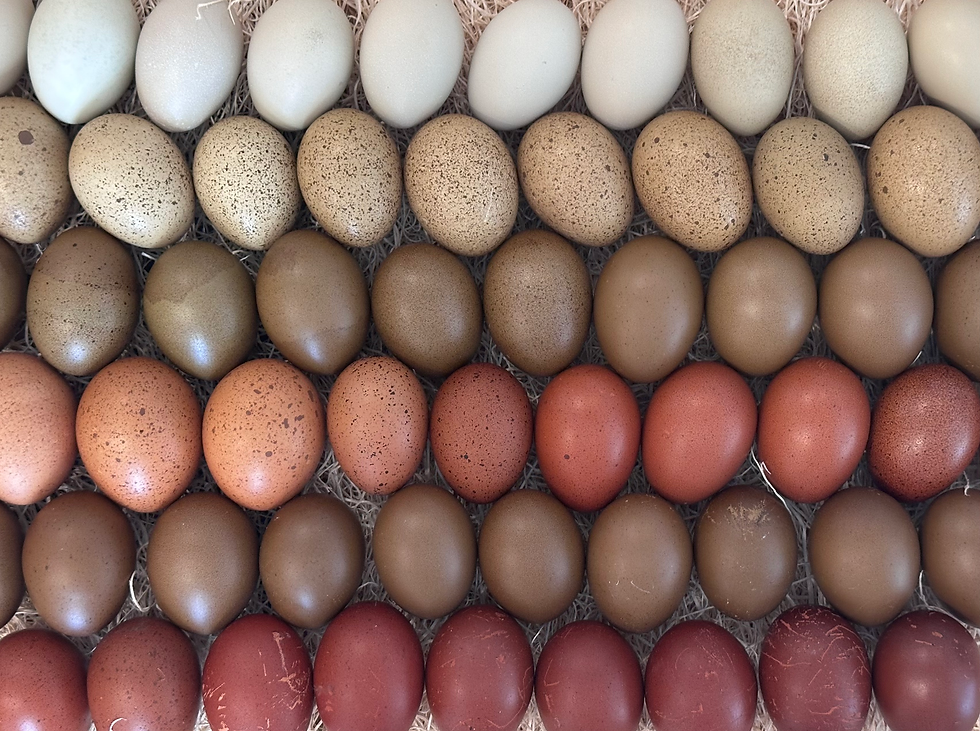
Some of the most exceptional Marans eggs appear nearly purple or black because heavy bloom diffuses and softens underlying Protoporphyrin IX deposition. This also explains why washed eggs often appear dramatically lighter or dramatically darker. The bloom modifies how light interacts with the shell surface.¹⁻⁵
Epigenetics and Environmental Influence (continued in Part Two)
One of the most controversial aspects of dark egg breeding is the role of environmental modulation.¹⁻¹⁵ Genetics establish potential, but environment determines expression.
Stress hormones, inflammatory signaling, nutrient availability, photoperiod, heat load, and microbiome composition all influence gene expression and metabolic output.⁹⁻¹⁵ This does not mean environment overrides genetics. It means genetics operates within a physiological context.
An elite genotype under severe metabolic stress may underperform a moderate genotype housed within optimal conditions. This is why I, as a dark line breeder, continually and ubiquitously obsess over:
environmental stability
exceptional feed quality and type with emphasis on maximal levels of nutrients
low-stress housing
ventilation
mineral balance
clean, filtered water free of biofilm
mitochondrial support
anti-inflammatory feeding strategies
reproductive recovery (no light supplementing) ⁹⁻¹⁵
The dark egg is extraordinarily unforgiving of physiological compromise.
In Part Two of this two-part blog, I will go over these environmental triggers in meticulous detail, including environmental assaults I have experienced (mycotoxins, E.coli, extreme heat) and how to combat them, as well as nutritional beacons that will guide your Marans to expressing their very best dark egg potential. Stay tuned…
References
Samiullah S, Roberts JR, Chousalkar K. Eggshell color in brown-egg laying hens — a review. Poultry Science. 2015.
Wang XT et al. The role of Protoporphyrin IX in eggshell pigmentation. Poultry Science. 2009.
Zhao R et al. Transcriptome analysis of the shell gland in brown egg laying hens. BMC Genomics. 2016.
Ishikawa SI et al. Molecular mechanisms of eggshell pigmentation in avian species. Journal of Poultry Science. 2010.
Ahn DU et al. Eggshell pigments and their physiological significance. Poultry Science. 2006.
Ferreira GC et al. Heme biosynthesis and regulation. Journal of Bioenergetics and Biomembranes. 2011.
Ponka P. Cell biology of heme. American Journal of the Medical Sciences. 1999.
Severance S, Hamza I. Trafficking of heme and porphyrins in metazoa. Chemical Reviews. 2009.
Surai PF. Natural antioxidants in poultry nutrition and reproduction. Nottingham University Press.
Dibner JJ, Richards JD. Antibiotic growth promoters in agriculture: history and mode of action. Poultry Science. 2005.
Oakley BB et al. The poultry gastrointestinal microbiome. Poultry Science. 2014.
Klasing KC. Comparative Avian Nutrition. CAB International.
Nys Y et al. Improving the safety and quality of eggs and egg products. Woodhead Publishing.
Solomon SE. Egg and Eggshell Quality. Iowa State University Press.
Etches RJ. Reproduction in Poultry. CAB International.
Board RG, Fuller R. Microbiology of the Avian Egg. Chapman & Hall.
Hincke MT et al. The eggshell: structure, composition and mineralization. Frontiers in Bioscience. 2012.
Bain MM. Recent advances in the assessment of eggshell quality and their future application. World’s Poultry Science Journal. 2005.

This is such a great read! As always, thank you for sharing all your knowledge.