Unlocking the Heme Pathway

Part Two: Epigenetics, Environment, and Flock Leader Stewardship: The key ingredients that will make or break your Dark Line Eggs
The first time I met Mal I was sitting at JFK airport getting ready to take a solo back-packing trip to Paris. I was 22 and in college and working as a travel agent to pay the bills. Back then, we got great perks and traveled for next to nothing. I sat down and across from her in the seats at the gate and I only noticed her because when I looked up from my book, I spotted a man talking uncomfortably close to her. Her head was down and she had her arms slipped inside her backpack as she held it close to her body. As women, we understand this body language.
I grabbed my boarding pass and sat down next to her and said “Well I couldn’t get us two seats together, but maybe someone will move.” She glanced at me confused but then immediately got it. “OK, we’ll ask on the plane,” she said. The weird guy left… Mal’s shoulders dropped and she took a deep breath. “Thank you so much,” she said in her breathy French accent. “He wouldn’t leave me alone.” We laughed and exchanged introductions.
As it turned out, we were actually sitting pretty close already on the plane and managed to get seats across the aisle from one another. We spent the entire 7+ hour flight talking, laughing and getting to know each other. She was from a region close to Chaillé-les-Marais, a small village that was known for their agriculture and biodiversity. She was part of a family of farmers that farmed primarily livestock. Mal was a few years younger than me, and she was attending college in Paris studying graphic design. By the time the plane landed, I canceled my hotel and took the RER with her to the fifth arrondissement, where she lived. Pretty much from that moment on, Mal and I became close friends, and every chance I could get (even sometimes just for a weekend!) I would fly to Paris and stay with her and do 20-something things.
One trip, I got to travel back to her home with her. She lived on an enormous parcel of land that was protected by a conservatorship in France. It’s similar to a UNESCO site, where the land is environmentally protected. It is typically held for hundreds, sometimes thousands of years by one family. Her family used the land to raise all kinds of livestock, including chickens, Marans among them. That was my first experience with the Marans breed. Looking back, it’s extraordinary to see how our past lives weave into our future ones without even realizing it.
Decades later, Mal took a very different role in my life. She became a mentor to me in this crazy world of breeding. No one knew the Marans breed better than she did. Among many incredible things she taught me, were a number of rules she impressed upon me that I have never wavered from and have served me at every turn with this, and frankly, all of my breeds:
Every outcome you will ever drive starts with your Rooster.
Know your birds better than they know themselves.
Get a second opinion.
Accept that you know everything and nothing at the same time.
Over time, I have added:
The egg is never lying.
Steward physiology over aesthetics.
Recovery is part of production.
More on Mal later…but make a mental note of these rules, because I will be referencing and expanding on them frequently.
Part two of this blog is going to be primarily based on my own personal experience. Where I live, the resources I have available to me, and the time I have to invest in these birds is unique to me, and I want you to take that to heart. Even my topography here in Southern California is going to present different challenges than the northern coast of Maine, or the rugged, high-pasture areas of Australia. But, I will do what I can to extrapolate these experiences into examples that are the most consistent possible, despite these differences.
Regardless of where you live, however, some of the strategies in this blog will make or break your pigment goals. I cannot impress upon you enough that much of what you see illustrated in your hens’ eggs are in your total and complete control at least some of the time.
Step 1: Selecting Your Breeding Stock
Disclaimer: I would be remiss if I didn’t at least say that you should choose birds that already come with some level of genetics for you to work with. This is obvious. But, as on-the-nose as it is, it is frankly the most important step you can take to accelerating your goals. You simply cannot accept compromise here. If you need a refresher on why, skip back to this blog: Three Hacks To Master That Will Level Up Your Breeding Abilities to understand why we simply cannot compromise with egg color.
But clearly, I recognize that not everyone has access to or the funds to invest in lines that are already primed. So, at a minimum, follow the strategies that are in this blog with your current flock, and you will unlock what is probably somewhat hidden in them already. Follow the protocols in the hack blog and just keep setting the darkest eggs you possibly can and then work from there.
Now that that is out of the way, step one is to choose the best breeding stock possible, which is inclusive of both your Dams and their Sire.
The Dams
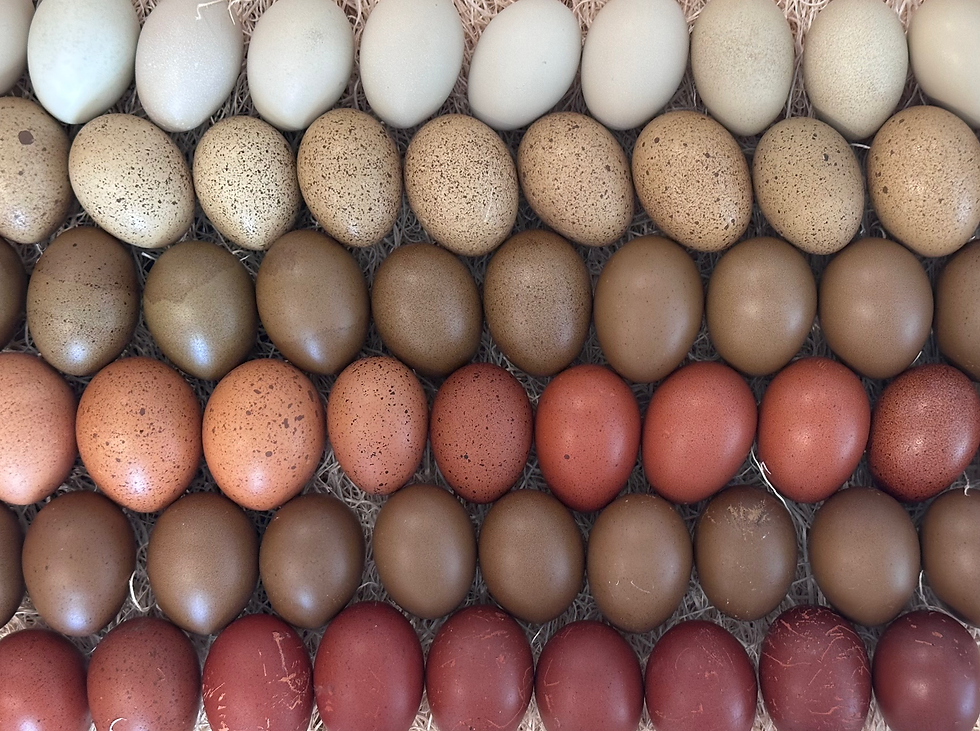
Among other traits, my dams have this in common: They each gave me at least one “9” color egg. I only needed to see one to know they had the potential for dark pigment. How often they would show that and how long they would sustain that was going to be completely unique to them and very much nurtured and stewarded by me.
Relying on the phenotype of the egg is essential because avian genetics is impossibly complex. For such a small creature, they have billions (billions!!) of genetic inputs that make up who they are and how they function in the world. They are extraordinary animals, and not just because of their complex genetics, but because of how cheeky they are with showing them to us. That is where phenotype comes in.
In addition to the 9 they have given, my Dams all possess the following qualities in common:
• They are all consistently dark pigmented layers (of course)
• They all take a fortnight and an engraved invitation’s length of time to lay one egg (as little as 3 hours and as long as 6 hours or more in the box)
• They all lay between 3 and 4 eggs per week
• They all have thin, vascular skin around their cloaca compared to my Marans that do not lay as dark (while largely anecdotal in my own flock observations, highly active laying hens often exhibit increased vascularity and softening of reproductive tissues associated with active oviposition and shell gland activity.¹⁵⁻¹⁷)
To underscore the converse, phenotype markers that have zero bearing on pigment are:
Melanization
Body Size
Standards Conformity
What I outline here are pigment phenotype markers. Breed type will not be discussed in this blog other than to point out what I culled for: I culled for eggs that did not meet size, weight, and bloom depth, regardless of the color – that is a sign of shell gland limitations and goes against a very important rule: SUBSTANCE over STYLE.
This means that I will not sacrifice the very thing that makes Marans special: their battle-ready resilience. That said, I have girls with copper you can see from space and girls that would disappear if the lights went out. Neither too much, too little, nor the absence of copper have anything to do with your girl’s reproductive system. It is purely coincidental based more likely on the breeding choices of breeders before me to breed forward pigment over SOP quality. While I can’t associate that to a public study, you’re just going to have to trust me on that one. ;)
I have six official girls in my Dark Line as of the publication of this blog: Belatrix, Adriana, Nera, Mal (yes, that one), Colette, and Stella. I have others that are “covered” by Major that also lay very dark, but didn’t give me a 9, like Mina, but six official.
I know these girls better than they know themselves. I have sat in the run and studied them for hours. I look at how they conduct themselves, their social hierarchy and dynamics, their general affect from day to day.
Why do I do this?
Because this sets my everyday precedence for these girls.
How they spend their day matters. If they are not feeling themselves, even though they will try their best to hide it, subtle cues will tip you off: the slightest dip in comb color, a mustard-colored dropping, a longer-than-usual or earlier-than-usual nap, more timidness around food and water than her place in her hierarchy would support, etc. The same goes for your sire, but I have found a quality rooster can take a longer and more direct beating before his genetics break down and his offspring feel the consequences. Typically, fertility itself is compromised first.
As I also lead and manage multiple businesses, I rely on cameras EVERYWHERE to be able to spy on them: in the coop from multiple angles and in the run from multiple angles. I can always spot a “tell,” and all of their unique “tells” matter. What are they telling me? They are telling me that something is…off. What that something is will almost always show up on her egg.
You want to get ahead of it before it does.
The Sire
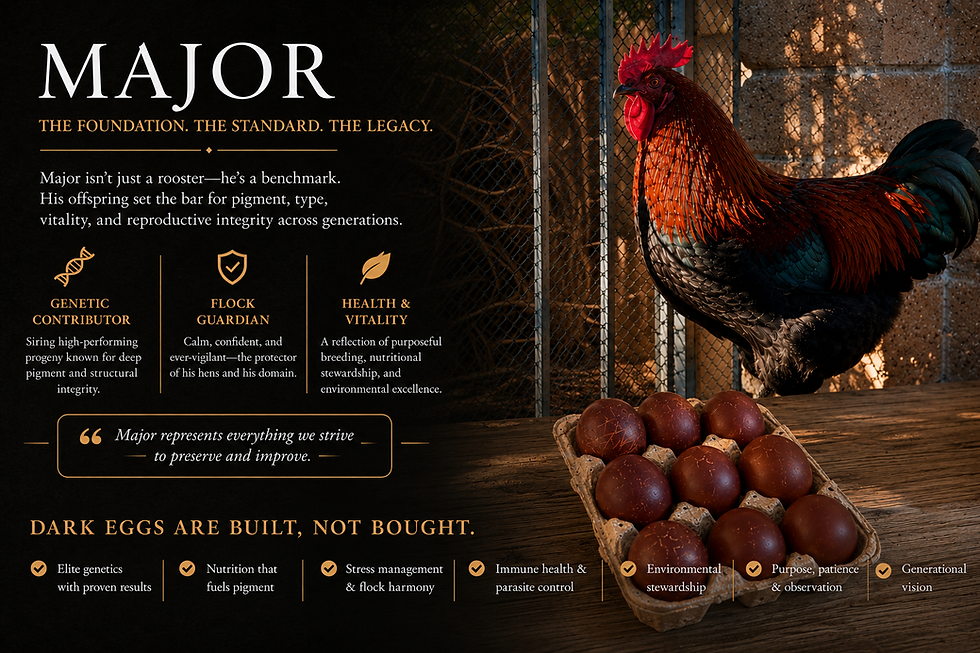
It would not be an overstatement to say that I hit the lottery with Major. I truly did. Not only does he have Olympic-level genetics, but he is also the consummate smooth operator. He is quietly confident, does not suffer fools, carries his flock with strength and poise, and the girls just swoon for him. He has, what my kids like to call, rizzzzz lol.
Early on, we nicknamed him Doctor Love because his mating precision was quite literally surgical. He was born for this job. The video below is a perfect example of his charm and his ease of pull-through with his females. This is his first time meeting Nera, Belatrix, Mal, and Nina. What a stud lol.
You may also notice something else about Major – he is gorgeous. Once again, lottery-won. Major is not only carrying exceptional reproductive genetics that will support and complement his Dam’s, but he is also just stunning in type. With very few exceptions, Major is a truly beautiful example of his breed.
This mattered to me because, as I deploy clan and spiral methods of breeding, eventually I want to have one line to rule them all: a beautiful SOP signature flock with show-stopping eggs, which brings us to…
Mal’s Rule Number One: Every outcome you will ever drive starts with your Rooster.
Major, and all flock leaders’ roles are complex and of paramount importance. A poor rooster will immediately stress your Dams out, and we know where stress leads…to pigment flushing down the toilet.
Your rooster must be beloved by your ladies.
You will know when he is not.
And if you don’t, then you are breaking rule number two: know your birds better than they know themselves.
Are the girls squatting quickly? Are they sleeping close to him? Are they responding immediately to his calls? Are they supporting the mating of others in the flock?
Have you ever noticed when a rooster steps into mating a certain female, the other females in the flock begin to attack her? That is representative of a flock leader who does not have control of his flock. Good flock leaders will lay down the law swiftly and with little effort. Female chickens want to be led by a strong flock leader, and they will fall in line as soon as they experience it.
Major is…how should I put it…skilled in the fertility department lol. He can handle A LOT of dams. At one point, I had 15 girls in his pen, and all 15 were consistently fertile for months.
Conversely, girls that are broody, physiologically compromised, or in their molting season are completely avoided by Major. That is an instinct you simply want to breed over and over.
Step Two: Dark Egg Pigment Starts at Hatch

This is where the rubber meets the road, ladies and gentlemen, because epigenetics, or the environment that your birds are nurtured in, is the key to whether or not they will reach their fullest potential.
It starts with their feed, their brooding environment, even vaccines that you choose to administer.
We currently vaccinate for Marek’s and Coccidiosis.
To be clear, I believe vaccinating your flock is a personal choice. But, for my flock, the evidence has been clear enough that the sum of the outcome of these vaccinations are clearly and distinctively worth it.
Dark egg production is metabolically expensive. Because of this, anything that influences systemic inflammation, nutrient allocation, immune activation, gut integrity, or long-term physiological stress may indirectly influence pigment stability and shell gland performance.
Could early-life vaccination programs influence the long-term physiology of elite dark egg layers?
Perhaps.
What I do know is this: if the dark egg truly represents a metabolic phenotype, then anything shaping long-term metabolic resilience may ultimately shape pigment expression as well.
Starter to Grower: The 0 to 16 Week Slingshot
One of the most overlooked realities in poultry breeding is that physiology is built long before the first egg is ever laid.
By the time a hen deposits her first layer of Protoporphyrin IX onto an eggshell, the foundation for that metabolic performance has already been developing for months through nutrition, immune programming, skeletal development, mitochondrial conditioning, gut maturation, and endocrine signaling.
This is why I continue using Nutrena NatureWise Chick Starter Grower crumble from hatch through sixteen weeks of age, and up to 8 weeks as their sole ration.
Does it contain corn and soy? Yes.
Would many “perfect feed” discussions online immediately reject it for that reason alone? Also yes.
But biology is ultimately measured in results, not ideology.
My chicks consistently demonstrate exceptional early growth, strong frame development, robust feathering, excellent vigor, healthy skeletal formation and remarkably consistent juvenile development on this feed.
Quite frankly, they thrive on it.
At this stage, caloric availability, amino acid sufficiency, consistency of intake, and digestibility become critically important.
I also strongly prefer crumble during early development. Young birds simply consume it more uniformly and efficiently than many alternative feed formats. There is less selective feeding, less sorting behavior, and more consistent nutrient intake across the flock.
Build the bird before you ask her to perform.
8 Weeks to 16 Weeks: Let’s Live a Little
Once my birds hit 8 weeks, it’s time to introduce them to the good stuff: fermented feed.
This is the avian equivalent to crack.
Fermentation is a great way to up-cycle nutrients in their feed. It can increase the bioavailability of both minerals and amino acids in a way that supercharges your bird.
I only ferment whole grains and do not ferment pellet or crumble. I also add back in vitamins and minerals that are lost through straining the feed as well as add additional supplements, which I layer in a week at a time to get them used to it.
I serve fermented feed twice a week, starting at 8 weeks and continuing on ad infinitum. Once they reach 16 weeks, they are maxing on all the added supplements I use in their feed:
• Spirulina (anti-oxidant support and micronutrient density)
• Chlorella (detoxification support and chlorophyll-rich nutrient source)
• Manuka Honey (immune and antimicrobial support)
• Brewer’s Yeast (B-vitamin support and gut health)
• Kelp (trace minerals and iodine support)
• Fish Meal (highly bioavailable amino acids and protein support)
• Camelina Oil (omega-3s and Vitamin E support)
• Fresh Garlic (immune and anti-inflammatory support)
• Herbs and Fresh Greens (phytonutrients and digestive support)
• Carrots, cabbage, arugula (carotenoids, fiber, and micronutrient diversity)
• Beet Root Powder (circulatory and nitric oxide support)
• CoQ10 Powder (mitochondrial and cellular energy support)
• Nutri-Balancer (broad-spectrum mineral and nutritional balancing)
• Fertrell Breeder and Show Supplement (breeding condition and reproductive support)
• Black Soldier Fly Larvae (protein, calcium, enrichment, and amino acid support)

Yes it is a lot. Yes it is exhausting. Yes it is expensive.
But this is what it takes to maintain full dark egg phenotype expression for as long as possible.
You are building a titanium, monumentally indestructible super bird.
Full Sexual Maturity: Stewarding the Athlete
At full maturity, my feeding philosophy becomes far less about simple growth and far more about physiological preservation. This is where exact ingredients become paramount. I convert all of my young, sexually mature (i.e. layers) to soy and corn-free feed immediately as close to before lay as possible.
My goal at this stage is no longer simply maximizing growth, but minimizing inflammatory burden, reducing excessive omega-6 exposure, limiting phytoestrogen intake, supporting mitochondrial stability, and preserving the endocrine and reproductive systems responsible for sustained dark pigment production. Research has shown that feeds absent of soy and corn support these goals.
Amino acids such as methionine and lysine are essential to your bird’s health, cannot be synthesized, and must be given in adequate amounts to feed your bird’s protoporphyrin capabilities. Too little and your pigment will suffer, too much and your birds will burn out and become overconditioned. In dark egg layers specifically, one of the most common patterns is spectacular early production followed by earlier-than-expected burnout. Both result in a total pigment collapse that is hard to recover from.
Many breeders successfully produce a dark egg once or early on.
Far fewer can sustain it for months at a time. Sustained pigment requires maintaining the hen herself. That means supporting:
• mitochondrial function
• amino acid availability
• liver health
• mineral balance
• microbiome integrity
• endocrine stability
• oxidative buffering
• reproductive resilience
• stress management
• overall feelings of bliss (seriously)
The egg is always communicating with you: A slight loss of bloom. A thinner shell. A washed-out saddle of pigment. A random white band. A subtle change in shape.
These are not cosmetic inconveniences.
They are biological telemetry.
I use the state of the egg to diagnose what my birds are missing in that moment. This requires a keen understanding of avian nutrition and the role amino acids and trace minerals play in “feeding” their reproductive systems.
My free choice feed is King Brand 19% Breeder/Layer Pellet. It contains roughly .47% methionine and .96% lysine. That is pretty darn close to ideal. But, that doesn’t mean your bird is going to get those levels every day. That’s just what it is in an average serving size, but on any given day, your birds may ingest dramatically more or dramatically less than those numbers. You will need to observe their condition and their egg’s performance indicators to know when you need to supplement. And no matter what, you will have to supplement at least some of the time.
My Black Soldier Fly Larvae supplementation cadence is one of the simplest examples of this systems-based approach. Whenever I observe that my hens need a quick methionine boost, I deploy this highly appreciated treat. I roll them in camelina oil first so that fish meal adheres directly to them, creating a highly palatable delivery system for amino acids, omega balance, Vitamin E support, marine minerals, and additional protein density, and hand-feed them about 2-3 tbsp per bird. No more, no less.
The birds go insane for it, and this feeds a social feedback loop with me as their handler that continues to associate my presence with good vibrations (i.e. blissssss). Win-win.
My supplementation cadence also matters enormously. I do not believe in hammering the bird with everything all at once indefinitely. I use the appropriate tool for the job, understanding that physiology likes rhythm. So I cycle strategically:
• oregano support after stress periods
• probiotics after antimicrobial intervention
• Oxine for environmental sanitation
• electrolyte and vitamin pulses during heat
• calcium gluconate support during shell instability
• higher antioxidant support during reproductive strain
• increased protein density during molt
• fermented feed rotations for microbiome support
Recovery is part of production, and being pre-emptive is part of avoiding the need to recover at all.
Everything Is Trying to Kill Your Chickens
There is a moment in every serious breeding program where theory collides violently with reality.
It is easy to build a beautiful flock during perfect weather, clean conditions, ideal fertility, and steady production.
It is something entirely different to preserve that flock through environmental assaults, pathogenic pressure, heat, parasites, infrastructure failures, reproductive stress, and the relentless physiological demands that elite dark egg production places on the bird itself. And I am not even going to cover predator avoidance, which is its own separate issue!
One of the most significant physiological assaults my flock has endured was mycotoxin exposure.
Pigment flattened. Bloom softened. Shell texture became inconsistent and then.. Mustard poops arrived. White banding appeared seemingly out of nowhere. Soft shells disintegrated in my hand. The ship… was going down.

Mustard poops are the bane of my existence. They are excellent biomarkers because they tell me something needs to be addressed… fast. But, what that something is, is an utter guessing game!
In this episode of mustard poops, it was mycotoxins. What makes mycotoxins particularly insidious is that they attack the exact systems dark egg production depends on most: liver function, mitochondrial efficiency, nutrient absorption, immune regulation, and oxidative balance.
We identified this was the issue through testing the feed. It came back positive for DONS. Typically, most chickens can handle a certain level of DONS, but as we know, dark layers will show you symptoms long before you may notice it in other birds. We immediately pulled all their feed, tossed it, sanitized their feeders, and changed feeds.
Just when we hit a rhythm with the new feed.. along came a brutal heat wave. In March. The heat wave was another reminder that even healthy birds can become physiologically compromised astonishingly fast.
Heat stress is catastrophic for dark egg physiology because it simultaneously impacts hydration, respiration, calcium metabolism, feed intake, oxidative stress, endocrine signaling, and mitochondrial output.
During heat events, everything shifts toward mitigation.
Electrolytes become essential. Antioxidant support increases. Water intake monitoring becomes obsessive.
I prepared by increasing their fermented feed that week ahead of the heat and running electrolytes for three days before, three days during, and three days after the heat wave. I still lost pigment. A lot of it. But thankfully, I didn’t lose any birds.
Heat waves in Southern California can be absolutely brutal. Last year it got up to 118 degrees Fahrenheit (48 Celsius) in their coops. I had to bring all of my birds inside my garage. The year before that, I brought them inside the house! This time, I was not taking any risks. I installed window unit a/c’s in every coop. It might have been a balmy 110 outside, but it was a cool 73 degrees inside their coop, and the misters and fans in the run kept them cool outside. And I still lost pigment. But we bounced back within two weeks, and my birds barely broke a sweat (apart from me, who was running outside every 10 minutes to check on them).
Once the weather returned to normal, we had a good run for a while. Then came… E. coli pressure.
The first clues were not dramatic illness.
They were subtle physiological whispers.
And then there they were… Mustard-colored droppings. Followed by… Slight reductions in bloom. Sporadic shell abnormalities. Tiny deviations from baseline that most people would never notice unless they knew their birds intimately.
Because by the time a chicken looks visibly ill, you are already late. I knew we had been observing more and more rodent activity, and since all other potential channels were eliminated (they had clean water receptacles and no access to standing water anywhere), I knew that it was rat exposure.
I responded aggressively:
• environmental lockdown
• water sanitation
• Oxine protocols
• strategic enrofloxacin intervention for one pen hit particularly hard
• probiotics
• fermented feed
• oregano support
• antioxidant support
• gut restoration
• covering feed and waterers before sundown
The goal is never simply to eliminate bacteria. The goal is often times restoration. You are not going to eliminate every assault, but knowing how to detect it, get ahead of it, or at least don’t let it get out of control will be the difference between a good season and one that ends devastatingly early.
Parasites created an entirely different type of assault.
External and internal parasites do not merely irritate birds. They create chronic physiological drain.
They can lead to blood loss. Sleep disruption. Immune stress. Feather damage. Behavioral stress.
Once again, the egg reflected the problem before the bird outwardly crashed. I went to collect an egg one day, and it was covered in lice. Poultry lice. The kind that lives on birds. The kind that rats bring in. I immediately got to work:
• I spread Spinosad everywhere, including the coop, nesting boxes, run floor, and even the birds themselves
• I ran a course of Exzolt, which is my go-to every quarter for getting ahead of parasite issues (I pre-emptively manage both internal and external assaults: Exzolt manages the external and Aquasol (dewormer) handles the internal)
Lice eliminated. And for now… the mustard poops have receded. Until next time…
Supporting and Preventing Overbred Hens
One of the more controversial strategies I employ is the use of what I jokingly call “concubines” within breeder pens.
These are strategically placed females that help buffer mating pressure away from my elite dams.
An overbred hen is a stressed hen.
And stress is the enemy of pigment.
I noticed feather loss and irritated skin from breeding friction in several of my girls, and so I introduced a few more concubines back into Major’s pen to bring them some relief. Pigment tanked. Because first ..they were stressed. New girls mean new competition. New girls mean less resources. New girls mean less time with Major. New girls = screw your pigment, lady.
But.. the new girls settled in. Major did his job managing the new hierarchy, and eventually it improved.
I want to impress upon you that I encountered ALL of these assaults within an 8-month timeframe.
The management of these issues is a full-time job.
It is exhausting.
But that is what it truly takes to maintain an elite flock.
Just like an Olympic athlete, managing an elite flock takes relentless attention to nutrition, recovery, stress, environment, and overall physiological health.
There are no participation trophies for the bare minimum.
Mal’s rule number 3: Get a second opinion.
Invest in finding a good mentor and excellent medical support, and become meticulous at keeping notes, collecting data, and looking for trends in any action, activity, or change.
And also understand that most people in the Marans world have not even come close to uncovering what I have in this blog because they simply have better things to do with their life lol, so continue to find new ways to unlock this breed that I haven’t even thought of (I will reserve more on this for rule number 4: accept that you know everything and nothing at the same time). This blog technically has been a year and a half in the making, but really, it’s probably been decades in the making. Mal knew much of what I now know and did her best to teach me along the way in her final years of life.
Now comes the hard part. We lost Mal last year. I lost Mal. I won’t get too far into it, but she chose to leave the earth the same way she did everything else… on her own terms. She leaves behind a legacy that will never be replaced. Not long after I met Mal, she lost her mother. This called her home to help her father and brother care for the farm. She spent the next 25 years of her life dedicated to raising the most incredible Marans I have ever seen. And none of them set foot inside a poultry show. They often saw the inside of a stockpot instead. She raised many breeds of birds over the decades she stewarded the farm, but in the last ten or so years, Marans became her one and only breed. Her family, in fact, helped to rebuild the Marans breed after World War II when they became all but extinct. She would tell you it wasn’t true, but anyone who truly knew her would tell you that she lived for those birds – and because of her, they, too, lived.
My favorite story of one of my first visits to her farm was the time we were out for a walk across the tall fields of whatever was growing that spring. Up ahead, I saw something in the tall grass moving fast, parting the tall weeds as it raced toward us. Mal told me not to move. So, I did not move. Suddenly, the largest, most incredible Marans rooster I have ever seen came flying out of the grass and whizzed by us like a bolt of lightning. We turned around just in time to watch this extraordinary giant leap feet first onto a running fox.
RIP to the fox…
Mal was my ear, my eyes, and my instincts. If it wasn’t for Mal, I would’ve culled Major. She saw what I didn’t. So did Holly, my other treasured mentor. Get a second opinion. You might miss something others will not.
The final rule: Accept that you know everything and nothing at the same time.
I realize the contradictory nature of this paradox is hard to hold in your head. But I will try to simplify it for you. For everything we learn about these birds, there are infinite things still yet to know. The chicken is one of the most complex animals on the planet. They are evolutionary diamonds. We continue to make exceptional progress in chipping away at their mysteries, but without significant amounts of funding and someone marching for a cause, we are left to accept the mere crumbs of what we know to be true.
I recently had the opportunity to have my birds tested for SNP markers that are known to indicate the propensity for high metabolic PpIX potential, among many other markers that were tested. What I discovered through this private testing is nothing short of groundbreaking, and I can’t even talk about it. The testing was done by a proprietary lab outside of the US, and I had to sign a non-disclosure agreement ahead of time. This greatly upsets me because I believe in the power of crowdsourcing knowledge. So, that is why I am doing my best to arm you with everything that I can share, and certainly my own personal experience, protocol, and methods that are mine alone to divulge.
And yet…
There are still lifetimes of information we will never access. So, the rule is simple. Become incredibly virtuous about what you do know. Understand it intimately and acutely, but also leave a boulder of room for new ideas, new discoveries, and new enhancements to your knowledge base. Because at the end of the day, uncovering the secrets behind this creature is really what makes this so fun, rewarding, and exciting. And if it doesn’t, then I suggest you find a new (less expensive) hobby.
My day with the birds at a glance
Each day, I wake up at dawn and let my birds out of their coops and into their runs. Their coops consist of sheds that have been converted. They have beautiful, hand-turned oak railings for perches, air conditioning units, comfortable nesting boxes, plenty of ventilation, and clean bedding. They are released into runs with automatic waterers that are fed filtered water and are typically also supplemented with probiotics, vitamin E, vitamin B6, or a broad-spectrum electrolyte and vitamin mix. Their flooring is fine, forest mulch, which composts beautifully. They are enclosed in hardware cloth and have very powerful fans and misters that line the inside perimeter. Their feeders are wall-mounted and at the perfect height. They have automatic doors that are manually operated at the moment, so that I can manage the uncovering of their feed and water, which is now fully covered each evening to keep out any unwanted vermin.
They are housed in appropriate numbers. Each rooster has his own limits as to how many females are best suited to him in his flock. For Colonel, it’s 8. For Major, the limit does not exist lol, but for now, it’s 12.
They get access to the outside, one pen at a time where they can scratch and explore. They get treats. They make leisurely returns back to their coops. They sleep together as one happy flock. They live a life of …bliss.
A final thought on feed and finding what may work for you
The feed that I use is King Brand Feed 19% Breeder / Layer pellet. It has .47 Methionine and .96% lysine. That is ideal. Over .50/1.00 and you risk burning out your birds, under .45/.85 and you risk your birds not getting what they need. Even with this balanced feed, I still must supplement because not every bird will eat exactly those numbers every time. So 3-4 times per week, I supplement with BFSL rolled in camelina oil and fish meal. This tops off their Amino acids, gives them a bit of a protein boost, and a vitamin E and omega-3 boost, which acts as an antioxidant, which we learned in part one of this blog is essential for defending against environmental assaults.
I use Mile Four Whole Grain layer feed as my fermentation base. I use probiotics with Bifidobacterium. I use Ropa poultry for an immune boost. I use these tools strategically and as needed. I cannot give you a perfect recipe for these interventions. They are unique to my flock’s situation, and nutrition certainly isn't as simple as hitting amino acid targets. But each of these tools can be used when you are also encountering assaults with similar symptoms.
Getting ahead of heat waves by running electrolytes, staying ahead of E coli issues by keeping waterers clean and sanitized, and keeping rodents out of feed. Storing and checking your feed regularly for any potential mycotoxin vulnerability, putting the effort into choosing the best flock members possible, and being ruthless about your standards is non-negotiable. Investing in secure and safe housing with plenty of ventilation, and maintaining clean grounds and coop interiors, and investing in the highest quality nutrition you can financially sustain are all going to be bare minimum efforts you will have to make to maintain a flock like this for a breeding season.
Not everyone can or will be able to do it. And that is why I sell out on this line within seconds. Because quality shows, and the work it takes to keep it is astronomical. There is room for more stewards of the dark line phenotype of this breed. I hope and encourage to see you there.


🔥💔💕 Excellent my friend. I’m in tears for so many reasons. Excitement, joy, sorrow and hope. I hope Mal can somehow see… Well done Jennifer, a thousand times over. Sincerely. HB
Thank you, Jen for sharing your knowledge and for mentoring so many of us. I always tell people that knowledge is power, but the moment you think you know it all is the moment you realize you know nothing at all.
I am so sorry to hear about your friend Mal. It sounds like she truly did her job here on earth and left a priceless mark on this world. Keep doing what you’re doing. Your passion, knowledge, and willingness to share are making a difference for so many of us, and I feel incredibly blessed to have your birds in my program.